Former DIPPER Lab Researcher Wins Best Paper Award at HBCU Blockchain AI FinTech Conference
A former Research Associate at the Distributed IoT-Platforms, Privacy and Edge-Intelligence Research (DIPPER Lab), Andrews Tang, has been recognised for his work in robotics and blockchain integration.
Now a graduate research assistant at North Carolina A&T State University, Tang is working under Dr. Balakrishna “Balu” Gokaraju in the Autonomous Vehicles Lab.
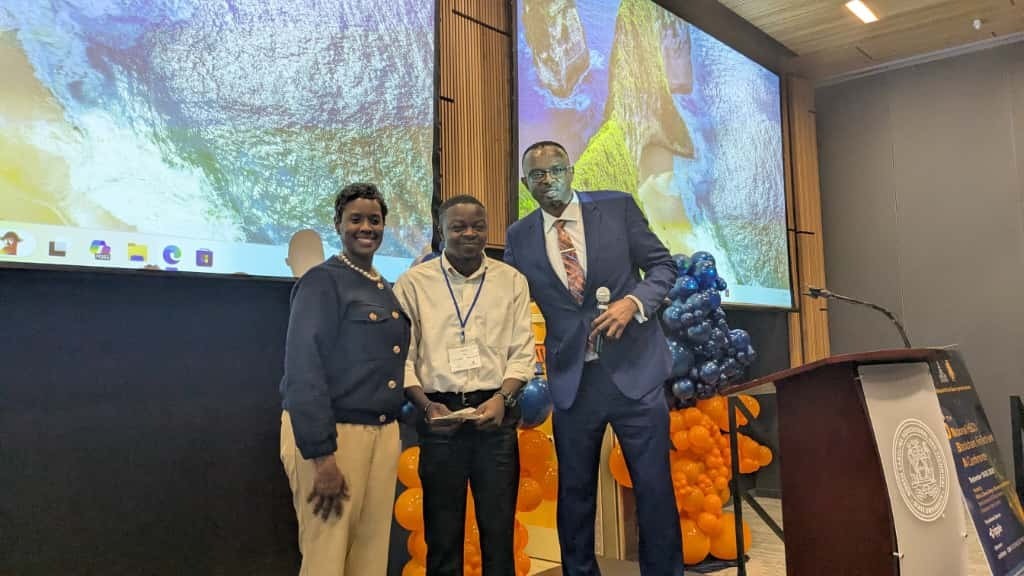
He recently earned the Best Paper Award at the HBCU Blockchain AI FinTech Conference for his project titled Trust Chain ROS.
His research focuses on enhancing the security of ROS2 (Robot Operating System), which serves as the middleware enabling communication between sensors, localization systems, motion planning, and control in robotics and autonomous vehicles.
While ROS2 facilitates real-time communication, it has lagged behind in addressing key security vulnerabilities.
“If the security mechanism in the commands that you send to a robot is not secure, a malicious attacker could manipulate the communication, and the robots may fail to perform critical tasks like extinguishing a fire or distinguishing crops from weeds,” Tang explained.
To address this challenge, Tang and his team developed a blockchain wrapper for ROS2 messages. The framework, dubbed Trust Chain ROS, creates permanent, tamper-proof records of robot communications. This provides audit trails, non-repudiation, and enhanced accountability, ensuring that each message can be traced back to its source.
The project also introduces an element of economic coordination among robots. Using tokenized microtransactions, robots can “pay” each other for sharing data such as LIDAR maps, enabling collaboration in multi-robot systems. Though the system doesn’t use real currency, these simulated transactions showcase the potential for scalable robotic teamwork in real-world scenarios.
Dr. Gokaraju described the work as timely and relevant to agriculture.
“Andrew’s work in self-driving robots for small-scale farmers is highly crucial for bringing smart agriculture solutions that address labor shortages while increasing crop yield. By combining microtransaction payments with blockchain, robots are rewarded for accuracy and precision — a game-changer for the future of agriculture,” he said.
Tang, who presented his research in traditional Ghanaian attire known as butakari, highlighted the cultural significance of the moment.
“I wasn’t expecting to win. I just wanted to share my work with a larger audience,” he said. “This recognition motivates me to keep refining my ideas and shows that with dedication and belief in your work, you can inspire people and create real impact.”
The award marks a significant achievement not only for Tang, but also for NCAT’s STEPS4GROWTH program, which highlights the role of HBCUs in advancing innovation in clean energy, robotics, and smart agriculture technologies.
DIPPER Lab is proud to see one of its former researchers making meaningful contributions in robotics and innovation.
We remain committed to supporting early-career researchers building secure, intelligent, and distributed IoT systems for real-world impact.