From Research to Impact: The Brain Behind DIPPER Lab’s SIWA Climate Intelligence Platform
Climate uncertainty continues to threaten the livelihoods of Ghana’s smallholder farmers, many of whom still make critical planting and harvesting decisions without access to reliable, localized weather information.
At the heart of an emerging response is the Smart Indigenous Weather App (SIWA), a climate intelligence platform developed by the DIPPER Lab at the Kwame Nkrumah University of Science and Technology (KNUST), in partnership with the Ghana Meteorological Agency (GMet).
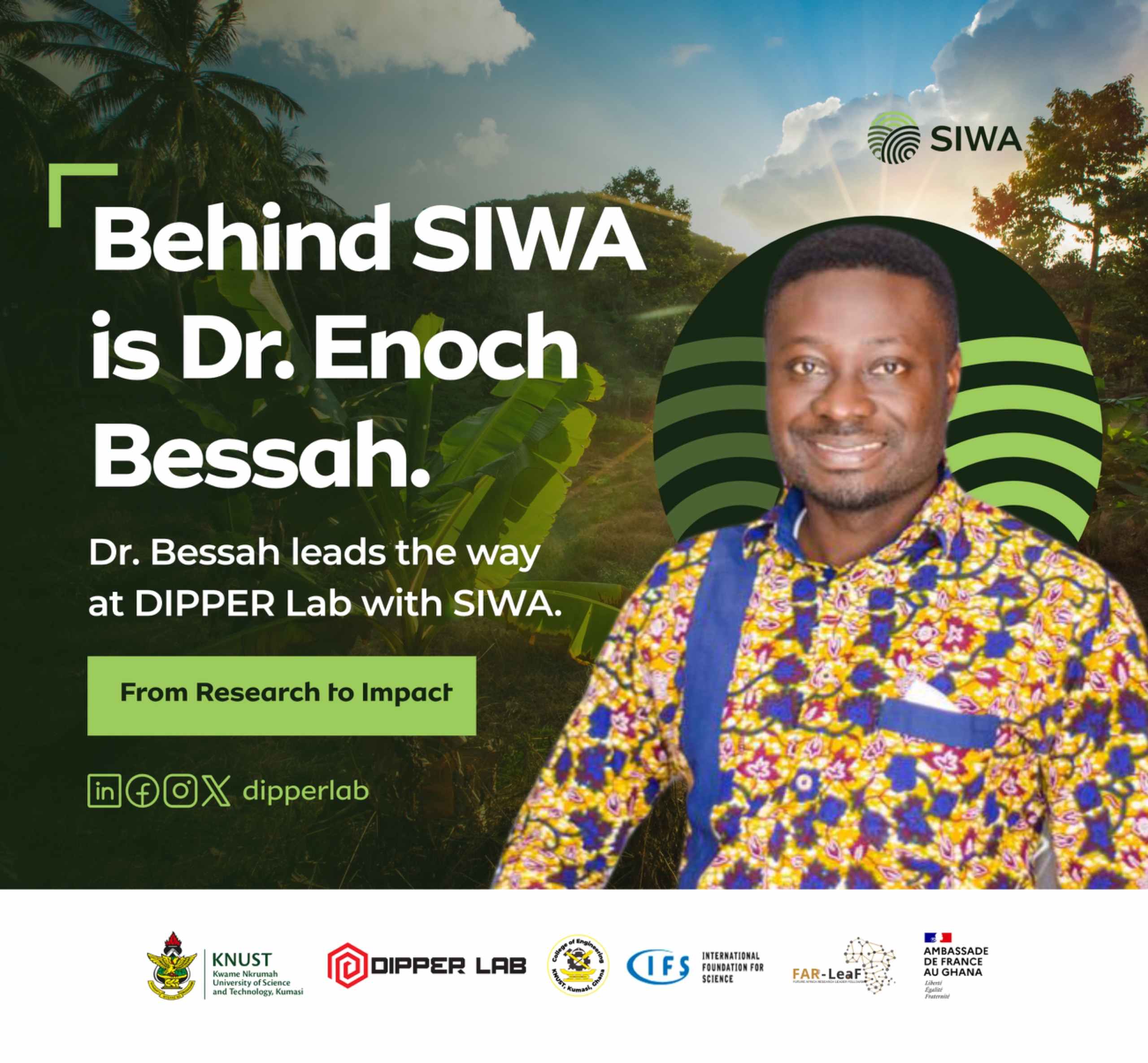
Behind SIWA is Dr. Enoch Bessah, Climate, Environment and Ecosystem Service Monitoring Team Lead at DIPPER Lab, a Senior Lecturer in the Department of Agricultural and Biosystems Engineering, and one of Ghana’s leading researchers working at the intersection of climate science, indigenous knowledge, and digital innovation.
The foundations of SIWA were laid between 2016 and 2019, during Dr. Bessah’s PhD research in the Pra River Basin. The study revealed a troubling reality: only about 30 per cent of farmers had access to scientific weather forecasts, even as climate variability intensified across farming communities.
Yet the research also uncovered something critical. Indigenous weather knowledge remained central to farmers’ decision-making and, in many cases, provided reliable, location-specific guidance that farmers trusted.
Rather than treating these local systems as outdated, the research demonstrated their value and potential when properly documented and validated. The study was funded by the Pan African University and the International Foundation for Science (IFS) and would later become the intellectual backbone of SIWA.
In 2022, Dr. Bessah’s work moved decisively from research toward application. Through a Postdoctoral Fellowship under the Future Africa Research Leadership Fellowship Programme, funded by the Carnegie Corporation of New York, he led a renewed focus on indigenous weather and seasonal climate forecasting in the Pra River Basin.
Working closely with GMet, the research team documented indigenous ecological indicators and validated them against satellite observations and historical meteorological records. This work also drew on earlier indigenous forecasting studies conducted in Northern Ghana, helping to strengthen the national relevance of the findings.
The result was a growing, validated dataset capable of supporting climate services that farmers could understand and trust.
The transition from datasets to a functional digital tool was supported by the Artificial Intelligence For Sustainable Development (AI4SD) project, funded by the French Embassy in Ghana. This phase expanded data collection and stakeholder engagement, involving agricultural extension officers, smallholder farmers, and the African data science community through a Zindi data challenge.
Under Dr. Bessah’s leadership, DIPPER Lab coordinated these efforts, ensuring that SIWA was shaped by both scientific rigor and real-world agricultural needs.
By combining scientific forecasts with validated indigenous indicators, SIWA presents climate information in formats that align with farmers’ decision-making practices.
Early evaluations involving more than 100 smallholder farmers in the Pra River Basin suggest that SIWA could help improve crop productivity by up to 40 per cent, with direct implications for livelihood income and food security.
Dr. Bessah has guided SIWA from field-based research to a scalable digital platform, coordinating interdisciplinary researchers, institutional partners, and development stakeholders along the way.
His work reflects DIPPER Lab’s broader mission, converting rigorous research into practical, impact-driven solutions that address Ghana’s most pressing development challenges.