EJP C-arouNd Holds its Maiden Workshop on Regenerative Agriculture, carbon storage and greenhouse gas emission in Ghana
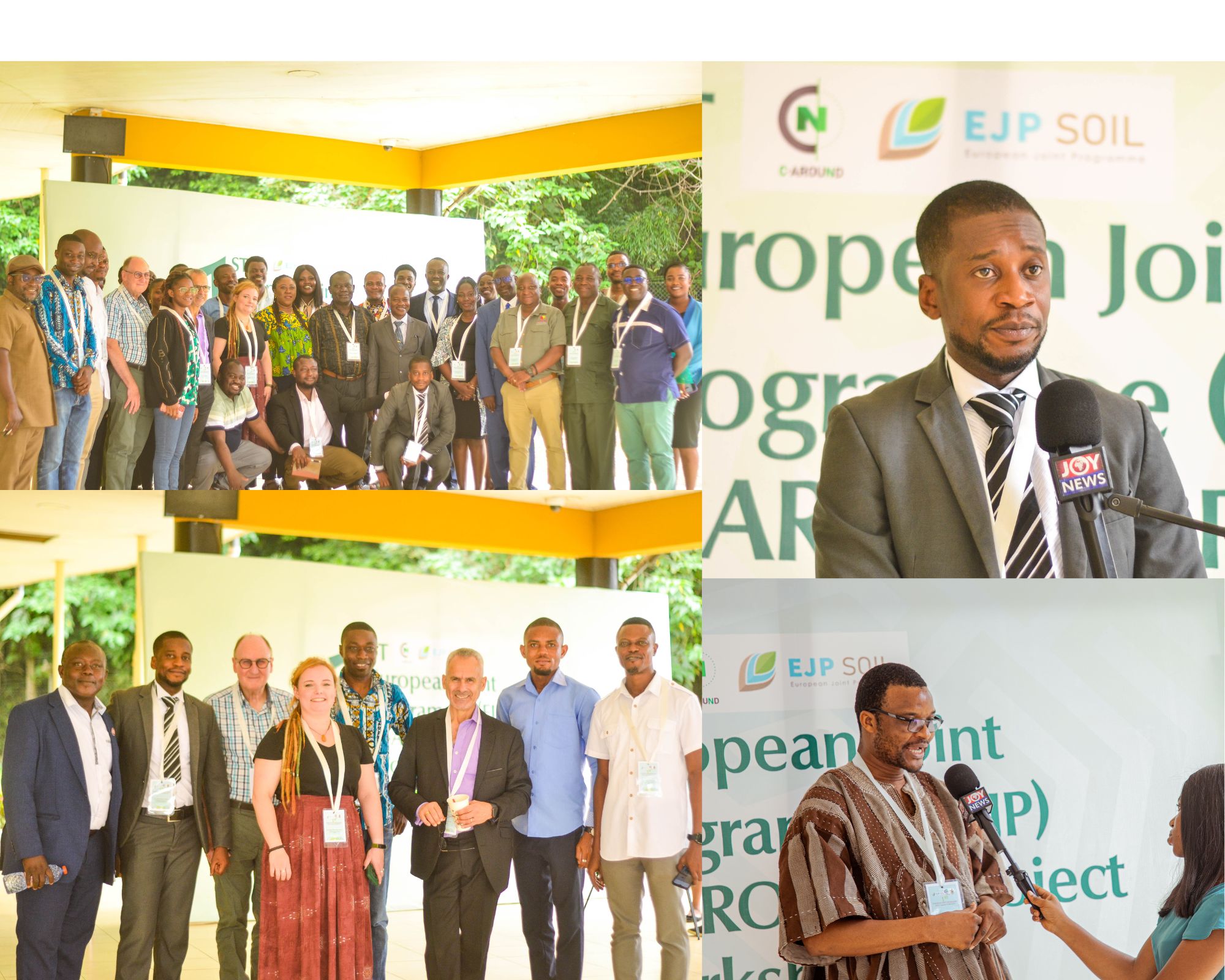
The European Joint Programme (EJP) C-arouNd Project has held its maiden workshop on regenerative agriculture at the Kwame Nkrumah University of Science and Technology (KNUST) in Kumasi.
The event was convened by Dr Caleb Melenya Ocansey, DIPPER Lab’s Lead for Partnerships in close collaboration with the Principal Investigator for KNUST, Prof. Vincent Logah, and the President of the Soil Science Society of Ghana, Dr Edward Yeboah.
The week-long event brought together scientists and researchers from 13 institutions across Africa, Europe, South America, and North American to explore innovative solution to soil health, regenerative practices, increasing soil carbon storage, reducing greenhouse emission and supporting Ghana’s climate-smart development.
Representing the Vice-Chancellor of KNUST, Prof. Samuel Asare-Nkansah, Dean of the Faculty of Pharmacy and Pharmaceutical Sciences (FPPS) and member of the University Council, said regenerative agriculture plays a key role in addressing soil degradation and climate change.
“Improving soil health, conserving biodiversity, and promoting sustainable farming are essential for food security and environmental sustainability,” he said.
Prof. Asare-Nkansah commended participating institutions for their collaboration and called for continued investment in research to help achieve the Sustainable Development Goals (SDGs).
Dean of the International Programmes Office at KNUST, Prof. Daniel Duah, said the EJP reflects the kind of global partnership the university seeks to promote.
“At KNUST, international cooperation is not only about the mobility of scholars but also the mobility of ideas that can transform societies.”
Through this workshop, we are connecting people, institutions, and cultures to advance scientific discovery and sustainable development,” he explained.
Deputy Director of the CSIR–Soil Research Institute, Dr. Patrick Ofori, emphasized the need to restore carbon to degraded soils through sustainable management practices.
“Using organic materials such as biochar, manure, compost, and crop residues helps improve soil fertility and reduce carbon emissions.
In this era of climate change, one of the most effective ways to cut emissions is to put carbon back into the soil in a stable form,” he said.
Dr. Eric Owusu Dankwah of the CSIR–Crop Research Institute said the workshop aligns with the institute’s mandate to promote sustainable farming systems that enhance productivity.
“We are committed to advancing farming systems that respond to climate change while improving yields, and this workshop supports that vision,” he noted.
President of the Soil Science Society of Ghana, Dr. Edward Yeboah, emphasized a global call to strengthen National Soil Information Systems to improve coordination and carbonization.
“We are of the view that principles would be put in place to ensure data sharing that would be relevant to the consortium, the society, and to Ghana as a whole,” he said.
The Regional Director of the Ministry of Food and Agriculture in the Ashanti Region, Mr. Godfrey Appiah said the country’s agriculture sector faces increasing challenges due to climate change and stressed the adoption of regenerative practices.
“Agriculture remains the backbone of our economy and a source of livelihood for millions. To sustain production, we must adopt regenerative and climate-smart agricultural systems,” the official said.
The Ashanti Regional Director of the National Communications Authority (NCA), Mrs. Diana Owusu-Ansah emphasized that “the Authority’s mandate aligns with the regenerative agriculture agenda, particularly through communication and real-time decision-making”.
Sharing insights on the project’s global scope, Dr. Abad Chabbi, Co-Principal Investigator, EJP C-arouNd, said the initiative seeks to create a global database covering diverse ecosystems and agricultural management practices.
“The project will assess how climate, soil type, and cropping systems influence carbon and nitrogen stocks, nutrient dynamics, and greenhouse gas emissions,” he explained.
The Principal Investigator of the project, Prof. Vincent Logah, said the initiative aims to standardize data collection and harmonize research efforts across partner institutions.
The workshop also featured a panel discussion moderated by Dr. Caleb Melanya Ocansey on the theme “Regenerative Practices on Soil Carbon Storage and Greenhouse Gas Emissions.”
Speakers included; Dr. David Whitehead, Lead, Drivers of Soil Carbon Stabilization and Vulnerability, Prof. Eric Tutu Tchao, Scientific Director, DIPPER Lab, Prof. Fred Nimoh, Dean, Faculty of Agriculture, KNUST, Dr. Edward Yeboah, President, Soil Science Society of Ghana and Dr. Abad Chabbi, Co-Principal Investigator, EJP C-arouNd.
Day one of the workshop ended with a tour of the KNUST campus, including the museum and various colleges.