Abstract
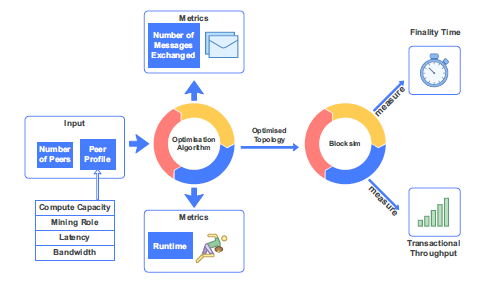
The Industrial Internet of Things collects data from the environment to improve industrial processes. Data integrity, privacy, authorisation, and authentication attacks are among the security vulnerabilities in traditional IIoT networks. Blockchain is a potential solution to some of these security issues. However, the throughput of traditional blockchains has been a major drawback. Blockchain’s throughput could be improved by enhancing its peer-to-peer (P2P) communications. In the literature, current blockchain implementations use Random-Neighbour-Selection (RNS) to establish the P2P network; that is, peers randomly select their neighbours. However, existing studies have shown that RNS limits the effective throughput. In this study, we identify and analyse how key node features impact the performance of the network. Furthermore, we also investigate the impact of an optimised P2P topology on performance in comparison to RNS. To achieve this, we propose a Software-Defined-Networking-inspired blockchain architecture that decouples blockchain data from network management. We then use a blockchain simulator we extended to simulate and investigate the impact of optimising the P2P network on performance. Compared to existing solutions, the results show that, despite having a longer runtime, our approach reduces the number of control messages and finality time by at least 16% and 20%, respectively, while increasing transactional throughput by at least 46%.