“High Production Costs Slow Progress on Carbon-Capturing Materials” — Dr. Odame
Dr. Prince Odame, Child Health and Innovation Lead at the Distributed IoT-Platforms, Privacy and Edge-Intelligence Research (DIPPER Lab), highlighted both the promise and the challenges of developing Functional Carbon-Capturing Materials (FCCMs) for regenerative agriculture.
Speaking on “Functional Carbon-Capturing Materials for Regenerative Agriculture” during Day Two of the European Joint Programme (EJP) C-arouNd Project Workshop at KNUST, Dr. Odame presented an in-depth overview of the science, applications, and future pathways for FCCMs in addressing climate change.
He explained that global carbon emissions continue to rise due to industrialization, fossil fuel combustion, and land-use changes, necessitating advanced materials that can efficiently capture and stabilize atmospheric CO₂. FCCMs, such as nitrogen-doped carbons, graphene composites, and modified biochars, offer a promising route by combining high surface area, tunable porosity, and functional chemistry for CO₂ adsorption and storage.
Dr. Odame detailed key design parameters influencing material performance, including pore structure, surface chemistry, and chemical functionalization with basic species such as polyethylenimine.
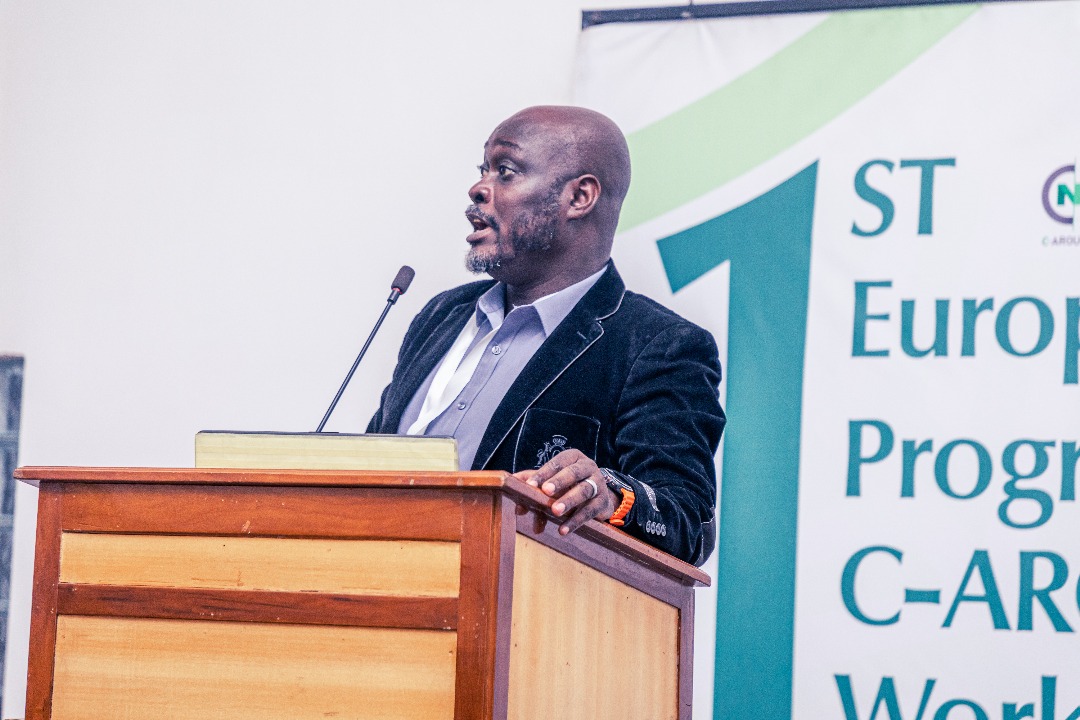
Dr. Prince Odame, Child Health and Innovation Lead, DIPPER Lab
He emphasized that ultra-microporous and heteroatom-doped carbons show superior performance in both direct air capture and soil carbon stabilization applications.
On the agricultural front, he noted that integrating these materials into soil systems enhances soil structure, microbial activity, and water retention while increasing total soil organic carbon (SOC) content.
Modified biochars, in particular, act as dual-function agents—capturing carbon while releasing essential nutrients that support regenerative farming practices.
In his discussion on measurement, reporting, and verification (MRV), Dr. Odame outlined the importance of data-driven monitoring systems that combine IoT sensors, remote sensing, and AI modeling to track carbon fluxes and validate sequestration outcomes.
Such frameworks are crucial for ensuring scientific credibility and policy alignment in carbon markets and agricultural certification schemes.
Despite their promise, Dr. Odame identified major challenges hindering large-scale adoption.
These include high synthesis and production costs, which can range between $10 and $50 per kilogram, variability in soil-material interactions, potential nanotoxicity concerns, and the absence of robust regulatory frameworks.
He noted that scalability remains a major technical barrier, especially for achieving gigatonne-level sequestration.
He called for collaborative innovation to overcome these barriers, including the development of eco-friendly synthesis routes such as hydrothermal carbonization, and coupling FCCM production with renewable energy systems.
“If we can develop continuous-flow synthesis systems and integrate them with sustainable energy sources, we can achieve scalable and cost-effective carbon capture,” he remarked.
Dr. Odame concluded that interdisciplinary collaboration across materials science, soil ecology, and digital monitoring will be key to realizing the potential of FCCMs.
“Functional carbon-capturing materials represent a transformative pathway toward sustainable carbon management and regenerative agriculture,” he said. “With continued research and investment, we can make meaningful progress toward global carbon neutrality by 2060.”
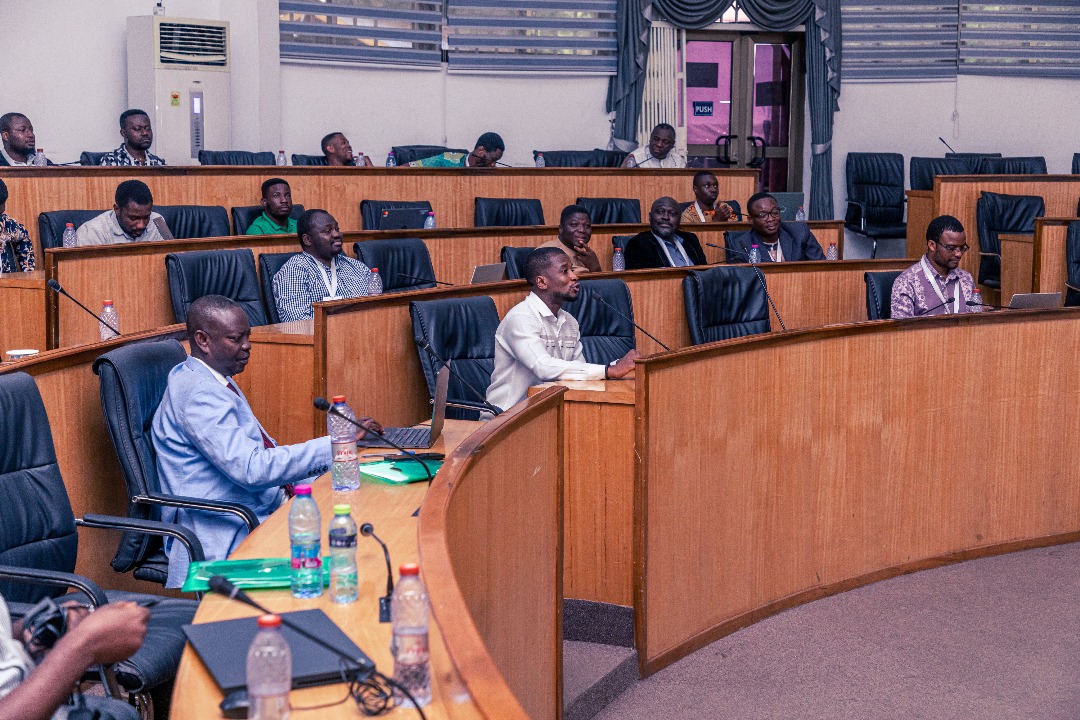
The EJP C-arouNd Project Workshop brought together scientists, researchers, and innovators to discuss regenerative practices, soil carbon storage, and greenhouse gas reduction, with Dr. Odame’s presentation serving as a highlight of the event.