
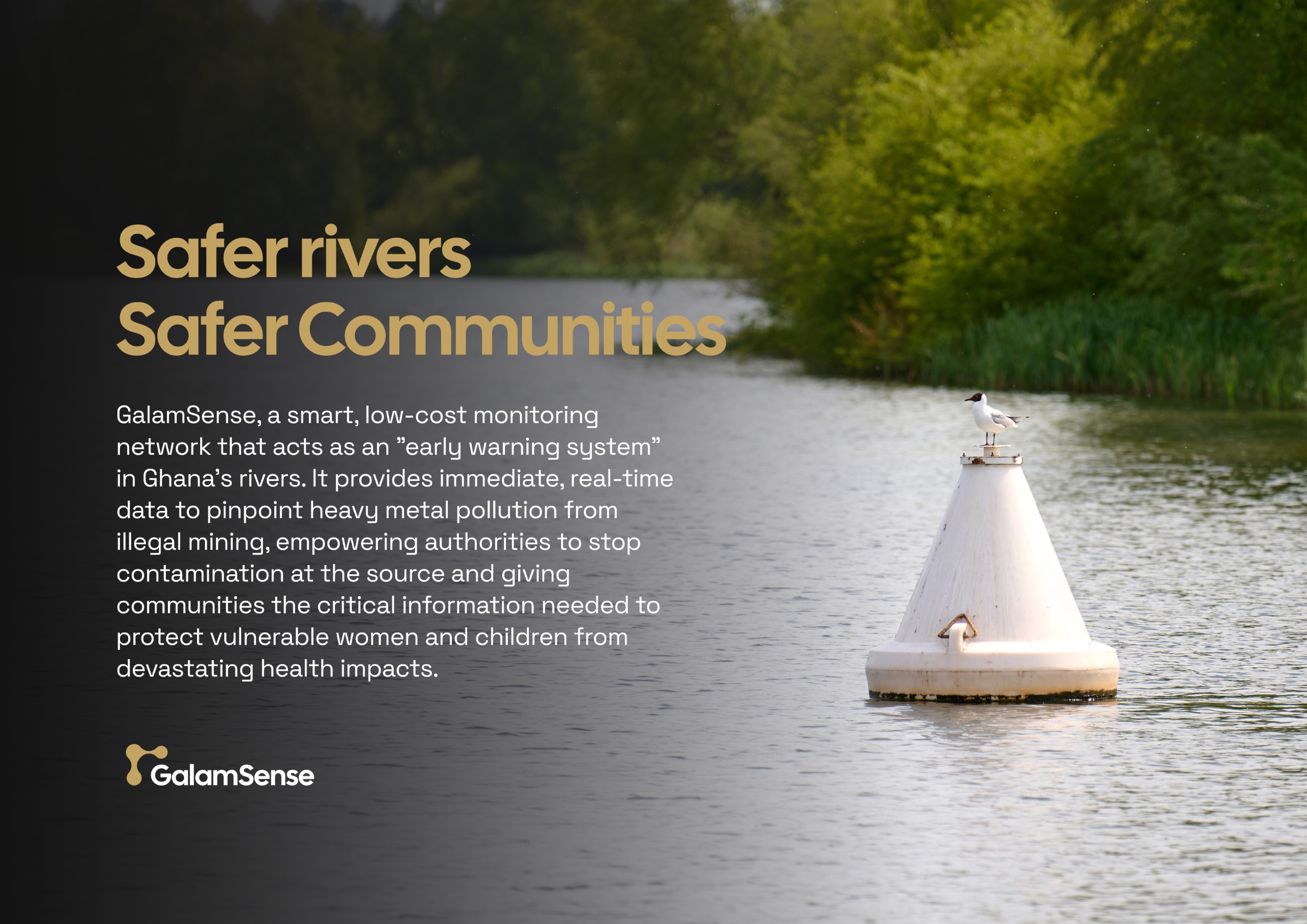
GalamSense addresses the critical environmental health crisis facing Ghana's river bodies: the invisible accumulation of heavy metal neurotoxins caused by illegal mining (galamsey). While the physical turbidity of our rivers is obvious, the real danger lies in undetected chemical contaminants like mercury, lead, and arsenic that persist long after the water looks clear. To solve this, we are developing a "cyber-physical" monitoring network that moves beyond reactive, manual sampling to predictive, real-time analysis. The system functions as an autonomous "immune system" for the water, detecting toxic events before they reach downstream communities.
The core of the project is a network of locally fabricated, solar-hybrid IoT buoys designed to withstand harsh river environments. Unlike standard sondes that only measure physical parameters like pH and turbidity, our hardware performs lab-grade electrochemical analysis in situ. We utilize an embedded electronic potentiostat to execute Square Wave Anodic Stripping Voltammetry (SWASV), allowing us to identify specific heavy metal concentrations at the molecular level. A microcontroller acts as the central hub, handling signal processing (filtering and curve fitting), managing the sensor array via an external ADC, and coordinating data transmission through LoRaWAN gateways to our cloud infrastructure.
This ground-level hardware is tightly coupled with "GalamCast," our predictive software platform. GalamCast utilizes deep learning models adapted from deforestation algorithms to analyze optical and radar imagery from Sentinel-1 and Sentinel-2 satellites, identifying spectral signatures of mining expansion. The system creates a unique "validation loop": the buoys provide the ground truth required to verify satellite predictions, constantly retraining the AI to distinguish between harmless mud and toxic runoff. By combining these on-device metrics with geolocation data from the deployed buoys, we generate live risk forecasts that empower environmental agencies to enforce regulations and rural communities to make informed safety decisions.
deputy scientific director
Scientific Director
researcher, mphil
researcher, mphil
research associate
researcher, mphil
researcher, mphil
Join us in our mission to develop innovative solutions through research and technology.
Get in Touch