
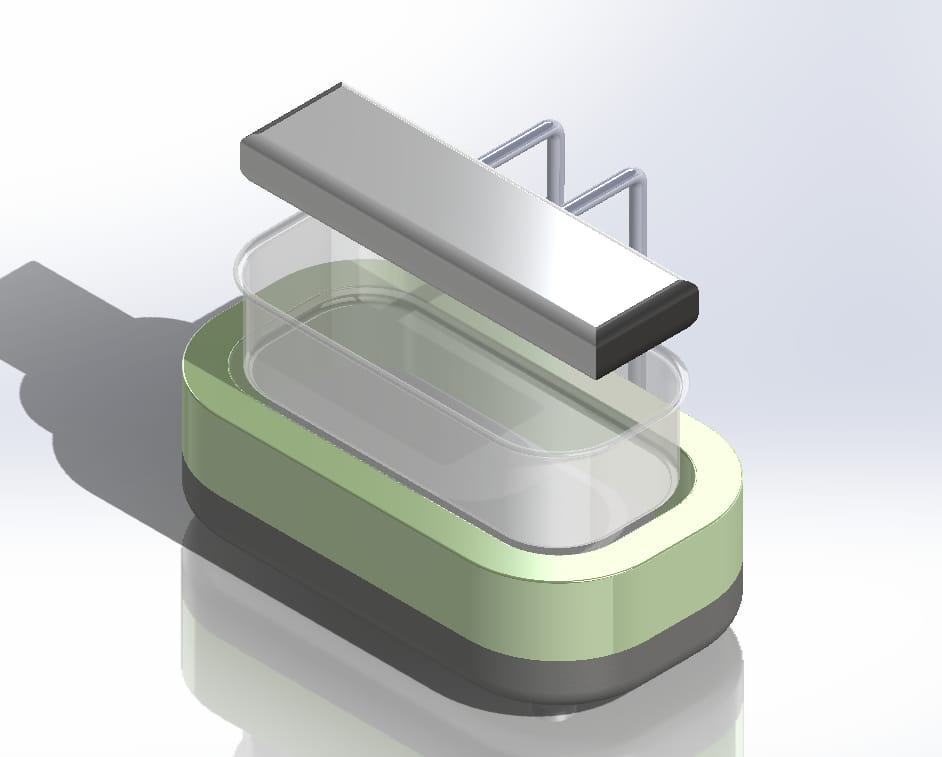
Neonatal jaundice remains one of the most common clinical conditions requiring treatment in newborns, particularly in low- and middle-income countries where access to high-quality phototherapy equipment is often limited. The High-Intensity Phototherapy Device (HIPD) project at Dipper Lab is an innovative initiative aimed at developing an affordable, high-performance medical device capable of delivering safe, uniform, and effective blue-light phototherapy for the management of neonatal hyperbilirubinemia. The project integrates biomedical engineering, optics, thermal design, electronics, and clinical user-feedback to create a system that meets international standards while remaining suitable for resource-limited settings.
The scientific basis of the device lies in the photochemical transformation (photoisomerization) of bilirubin. Newborns often accumulate high levels of unconjugated bilirubin due to immature liver function. The HIPD utilizes blue light in the 460–470 nm wavelength range, which corresponds to the absorption peak of bilirubin. This process converts bilirubin into water-soluble photoisomers that can be safely excreted without the need for hepatic conjugation. Delivering the correct spectral irradiance, maximizing the illuminated skin surface area, and maintaining thermal and photobiological safety are therefore critical design drivers.
Thermal safety is an essential consideration since high-power LEDs generate significant heat during operation. The HIPD integrates aluminum heat sinks, forced-air cooling from quiet medical-grade fans, and real-time monitoring using DS18B20 digital temperature sensors. An ATmega328P microcontroller coordinates LED intensity control, temperature safety protocols, user interface functions, and device-health indicators. The mechanical structure uses durable, hospital-safe materials: ABS for the opaque body, PMMA for the LED window, stainless steel for the support frame, and hard-coated polycarbonate for the scratch-resistant transparent bassinet enclosure.
The HIPD project demonstrates Dipper Lab’s vision of designing context-appropriate medical innovations through scientific research, computational engineering, clinical collaboration, and iterative prototyping. Upon completion, the device will stand as an affordable, high-performance phototherapy solution tailored for neonatal care in Ghana, Africa, and beyond, contributing meaningfully to reducing preventable complications from neonatal jaundice.
deputy lead, child health & Innovation
research associate
lead, child health & Innovation
research associate
Join us in our mission to develop innovative solutions through research and technology.
Get in Touch