
Infant apnea remains a critical concern in neonatal care, particularly in low-resource settings where continuous monitoring tools are either unavailable or unaffordable. Prolonged pauses in breathing within infants, often accompanied by drops in heart rate and oxygen saturation, can go unnoticed during sleep, increasing the risk of long-term complications and life-threatening events. Caregivers, especially new parents and overburdened nurses, lack accessible, reliable tools that provide timely alerts when infants experience abnormal respiratory patterns.
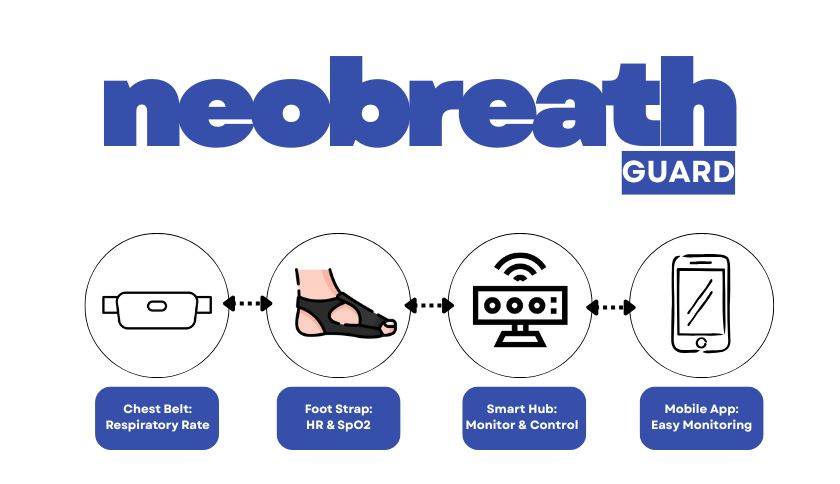
To address this gap, the NeoBreath Guard project is developing a compact, wearable, sensor-based monitoring system that detects breathing irregularities in real time and immediately notifies caregivers. Built around low-power embedded systems, capacitive sensing, and optical SpO₂ monitoring, the device aims to offer hospital-grade vigilance in a form that is affordable, comfortable for infants, and suitable for both clinical and home environments.
The first prototype integrates a capacitive sensor, optical heart-rate and oxygen-saturation module, haptic alerts, and wireless communication. Initial testing confirmed core functionality, reliable breath-pause detection, stable signal acquisition, and responsive alerts—but also highlighted areas for refinement, including sensor placement optimisation, improved motion-artefact filtering, and extended battery performance.
The ongoing phase focuses on these adjustments, refining both hardware and firmware to enhance accuracy, reduce false alarms, and improve the user experience. With these improvements, NeoBreath Guard is advancing toward a robust, user-friendly monitoring solution that strengthens infant safety and supports caregivers across diverse settings.
deputy lead, child health & Innovation
lead, child health & Innovation
research associate
researcher, mphil
researcher, mphil
Turibius Adalebse Nyaaba
Join us in our mission to develop innovative solutions through research and technology.
Get in Touch